
How to Remember BJJ Techniques: A System That Actually Works
Introduction
You are not forgetting BJJ techniques because you are a bad student. You are forgetting them because no one ever gave you a system for retaining what you learn.
Most grapplers walk off the mat after a great class, head home, and within 24 hours have lost the majority of what they just drilled. It feels frustrating, like your brain is working against you. The truth is, it is not your brain's fault. It is just doing what brains do without a retention system in place.
The good news is that the science of memory and skill acquisition gives us a clear picture of why this happens and exactly what to do about it. This post breaks it down and gives you a practical system you can start using today.
Why Your Brain Forgets BJJ Techniques So Fast
In the 1880s, German psychologist Hermann Ebbinghaus conducted a series of experiments on memory that produced one of the most important and most replicated findings in cognitive science: the forgetting curve.
His research showed that without any reinforcement after learning something new, people forget roughly 50% of that information within an hour. Within 24 hours that number climbs to around 70%. By the end of the week, up to 90% of the original material is gone.
For BJJ students this is a serious problem. You go to class two or three times a week, learn a new technique or series each session, and without any reinforcement between classes that material fades fast. By the time the same technique comes up again on the mat, it feels brand new.
This is not a reflection of your intelligence or your dedication to the sport. It is simply the forgetting curve doing what it always does.
The Problem Goes Deeper Than Memory
The forgetting curve explains why you lose techniques quickly, but there is another layer to the problem specific to physical skill acquisition.
Research on motor learning, including the foundational work of Schmidt and Wrisberg in Motor Learning and Performance, shows that techniques learned in isolation are significantly harder to retain and transfer than techniques learned in context. When you drill a single move repeatedly without connecting it to what comes before or after it, your brain stores it as an isolated fragment. Isolated fragments are easy to lose.
This is why you can drill an armbar a hundred times in class and still struggle to hit it in a live roll. The move exists in your memory as a standalone action, not as part of a connected flow. When the chaos of sparring arrives, your brain cannot find the thread.
The grapplers who retain and apply techniques most effectively are not necessarily drilling more than everyone else. They are drilling with more context, connecting techniques to positions, to setups, to follow ups, and to their broader game.
What a Real Retention System Looks Like
The science points clearly toward four habits that dramatically improve technique retention for BJJ students.
1. Log techniques shortly after learning them
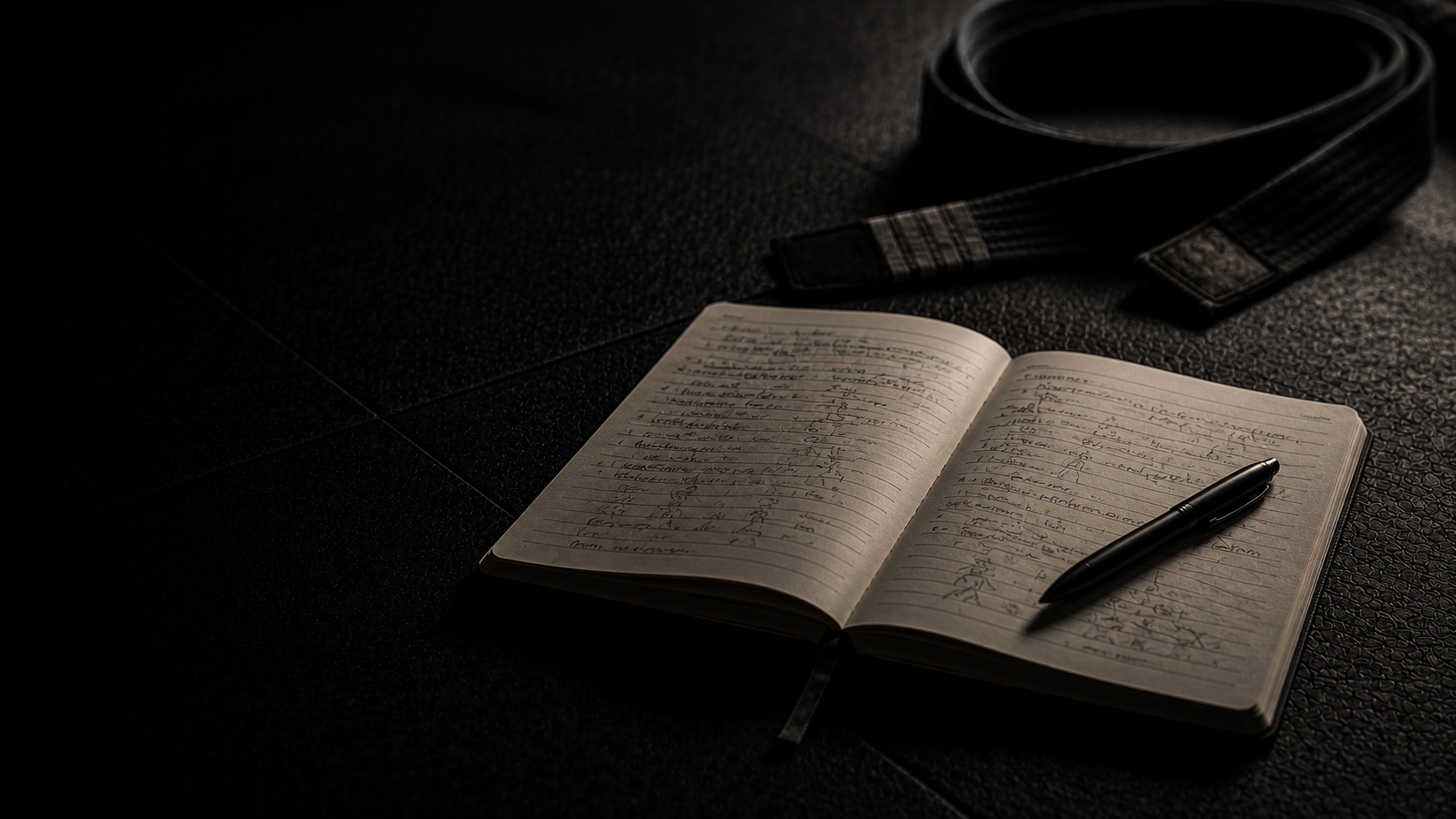
Cognitive science consistently shows that writing down information shortly after learning it significantly improves long term retention. You do not need to write an essay. A few sentences covering what the technique is, the key details, the position it comes from, and any notes on how it felt to drill is enough. The act of writing forces your brain to process the material a second time while it is still fresh.
2. Connect every technique to its context
Never store a technique in isolation. Every move belongs somewhere in your game. What position does it come from? What are the setups? What do you do if it does not work? What does it connect to? Answering these questions when you log a technique builds the contextual web that makes retrieval under pressure possible.
3. Review using spaced repetition
Spaced repetition is the most evidence-backed method for long term retention of any kind of information. The concept, developed from Ebbinghaus's original research and refined by cognitive psychologists including UCLA's Robert Bjork, involves reviewing material at increasing intervals over time. Instead of cramming everything at once, you review a technique the day after learning it, then three days later, then a week later, then two weeks later. Each review reinforces the memory trace and pushes the next review further out. Flashcard systems are the most practical way to apply spaced repetition to BJJ study away from the mat.
4. Build chains and systems, not isolated moves
The most effective thing you can do for your retention and your overall game is to stop thinking about techniques as individual items and start thinking about them as parts of a connected system. Build chains of moves that flow from one to the next. Map out your game from each position. When your brain understands how everything connects, losing one piece of the chain does not mean losing the whole thing.
Putting It Into Practice
Here is what a simple retention system looks like in practice.
After every class, take five minutes to log what you learned. Write down the technique, the position, the key details, and any personal notes. If the technique connects to something you already know, note that connection explicitly.
Once a week, review your recent logs and spend ten minutes on flashcard study. Go through your techniques, test yourself on the details, and flag anything that feels fuzzy for extra review.
Every month or two, revisit your positional systems and update them. Add new techniques you have picked up, adjust chains that are not working, and identify gaps in your game that need attention.
That is it. Five minutes after class, ten minutes once a week, and a monthly review. The consistency of the habit matters far more than the volume of the effort.
How BJJ Combos Supports This System
BJJ Combos was built specifically around the retention and development habits described in this post.
The Moves Library gives you a structured place to log every technique you learn, with fields for position, tags, and personal notes. The Combo Builder lets you chain techniques together so nothing lives in isolation. The Systems tool lets you map your entire game from each position so every technique has a home. The Training Journal gives you a dedicated space to log every session. The Flashcard and Vocabulary system lets you study your own techniques using spaced repetition anywhere, anytime.
Every module in BJJ Combos exists to support one of the four retention habits outlined above. It is not a coincidence. It is what the platform was built to do.
You can create a free account at app.bjjcombos.com with no credit card required and start building your retention system today.
The Bottom Line
Forgetting BJJ techniques is not inevitable. It is the predictable result of training without a retention system. The science of memory and motor learning gives us a clear picture of what works: log techniques promptly, connect them to context, review them with spaced repetition, and build chains and systems rather than isolated moves.
The grapplers who improve the fastest are not always the most talented or the most athletic. They are the ones who treat their development as a system and show up to every class and every roll with a more organized, more intentional game. Start building yours today.